


Commercial real estate (CRE) properties come in all shapes, sizes, conditions, and locations. While this diversity creates a wide range of opportunities for investors, it can make comparisons difficult without a shared framework.
To address this, the industry uses a standardized property classification system that organizes assets by property type and building class. Together, these designations act as a shorthand for communicating a property’s quality, location, risk profile, and income potential.
In this article, we explain the four main commercial property types—office, industrial, retail, and multifamily—as well as the three commonly investable commercial building classes: Class A, Class B, and Class C.
Commercial Real Estate Building Classes
A property’s building class is a shorthand description that helps investors understand its relative position in the market based on factors such as age, location, construction quality, tenant profile, rental rates, and pricing. While boundaries between classes are not absolute, the system is widely understood and consistently applied across the industry.
Building Class A
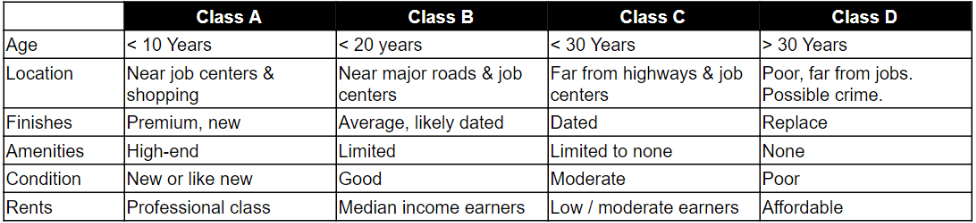
Class A buildings are the newest and highest-quality properties in their market. They are typically less than ten years old and located in or near central business districts or other highly desirable areas of major cities. These locations tend to offer strong visibility and high traffic counts for both vehicles and pedestrians.
Class A properties feature top-tier finishes, modern building systems, and robust amenity packages. For example, a Class A office building may include marble floors, high-speed connectivity, outdoor terraces, and energy-efficient systems, sometimes evidenced by LEED certification.
Because they are generally new or like-new, Class A properties require minimal near-term capital expenditures. As a result, they command the highest rents and sales prices, often trading at cap rates in the 4%–5% range. These assets are considered the lowest-risk building class, supported by strong tenant credit and stable cash flow, though upside potential is typically limited.
Building Class B
Class B buildings are well maintained but may be slightly dated and in need of light renovations. They are often between 10 and 20 years old and located in solid, though not top-tier, submarkets.
Finishes in Class B properties are generally functional but not cutting edge. For example, a Class B multifamily property may feature tile flooring, laminate countertops, carpeted bedrooms, and older fitness facilities.
These assets are usually in good overall condition, with fully functioning mechanical and HVAC systems, though modernization is often needed. Rents are lower than Class A, making Class B properties accessible to small-to-mid-sized businesses and median-income tenants. From an investment perspective, returns typically come from a blend of current income and appreciation, particularly where value-add improvements are executed effectively.
Building Class C
Class C buildings are older, dated properties that generally require moderate to significant repairs. They are typically 20 to 30 years old and located in less desirable areas, often farther from major employment centers, transportation corridors, and retail hubs.
Finishes are usually outdated or obsolete, and capital improvements are often required for systems such as roofing, parking lots, HVAC, or plumbing. Rents are lower than Class B and tend to cater to small businesses or hourly-wage tenants.
While Class C properties carry higher operational and tenant-credit risk, they are also priced at a meaningful discount. For investors with higher risk tolerance and hands-on operating expertise, these assets can present attractive opportunities to create value through renovation, repositioning, and improved management.
Building Class D
There is, in fact, a fourth classification of commercial buildings; Class D properties. These are highly speculative and not considered investment grade. Typically, they are very dated and in need of significant repairs or a complete rebuild. They are more than 30 years old and have poor locations in areas without access to transportation networks, restaurants, grocery stores, or other amenities. In addition, the location may be in an area where crime is an issue.
These are properties that can be acquired at an attractive price, but the capital investment needed to bring them to market standards can be significant and it can be months or years before the investor sees any sort of return in the form of income or appreciation.
The table below summarizes the differences between property types:
Commercial Property Types
In addition to building classes, investors should understand the 4 primary commercial property types, as each comes with its own underwriting considerations, risk factors, and operating dynamics.
1. Office
Office properties are designed to support business operations and range from high-rise towers in major urban centers to suburban office park buildings. Spaces may be general-purpose or tailored to specialized tenants such as medical practices.
Office investors benefit from longer lease terms and typically lower tenant turnover. However, leases often include slower rent growth, and tenant improvements can be costly when attracting or retaining occupants.
2. Industrial
Industrial properties include warehouses, logistics facilities, and flex space used for distribution, storage, or light manufacturing.
These assets often feature predictable cash flow, lower operating expenses, and modest capital expenditure requirements. That said, their large footprints can require higher upfront investment, and performance may be sensitive to broader economic cycles.
3. Retail
Retail properties serve direct-to-consumer businesses and include strip centers, shopping centers, and single-tenant outparcels.
Retail assets benefit from visibility and long-term leases, but tenant performance can be influenced by consumer behavior and market trends. In addition, retail spaces are often built for specific uses, which can make re-leasing more expensive without renovations.
4. Multifamily
A multifamily property contains five or more residential units and is considered a commercial asset.
Multifamily investments tend to offer relative stability, even during economic downturns. However, they typically involve higher tenant turnover, shorter lease terms, and ongoing management demands.
Why Building Classes and Property Types Matter
A property’s type and building class provide investors with a practical framework for evaluating risk, return potential, and strategic fit. While classifications are not perfectly precise, they are widely accepted and help streamline both deal sourcing and underwriting.
In practice, investors often use these classifications to narrow opportunity sets—either through online platforms or by communicating specific criteria to brokers (e.g., “Class B industrial” or “Class C retail”). This shared language allows investors and advisors to align more efficiently and focus due diligence on opportunities that best match investment objectives.
Understanding how property types and building classes interact is a foundational step toward building a disciplined, risk-aware commercial real estate portfolio.
Want to Learn More About CRE Classifications?
First National Realty Partners is one of the country’s leading private equity commercial real estate investment firms. We tend to employ a “value-add” approach, which means that we typically seek out Class B or Class C retail properties that we can acquire at a good price and realize its upside.
If you’d like to learn more about CRE, we’d be happy to have a conversation. You can reach us here.


